
SAP and Customs Clearance in India: Why the Gap Between Your ERP and the Port Is Costing You
SAP knows a PO was raised and a GRN was posted. It has no visibility into customs filing, duty paid, or clearance status. Here's why, and what closes the gap.
What SAP Actually Knows, and What It Doesn't
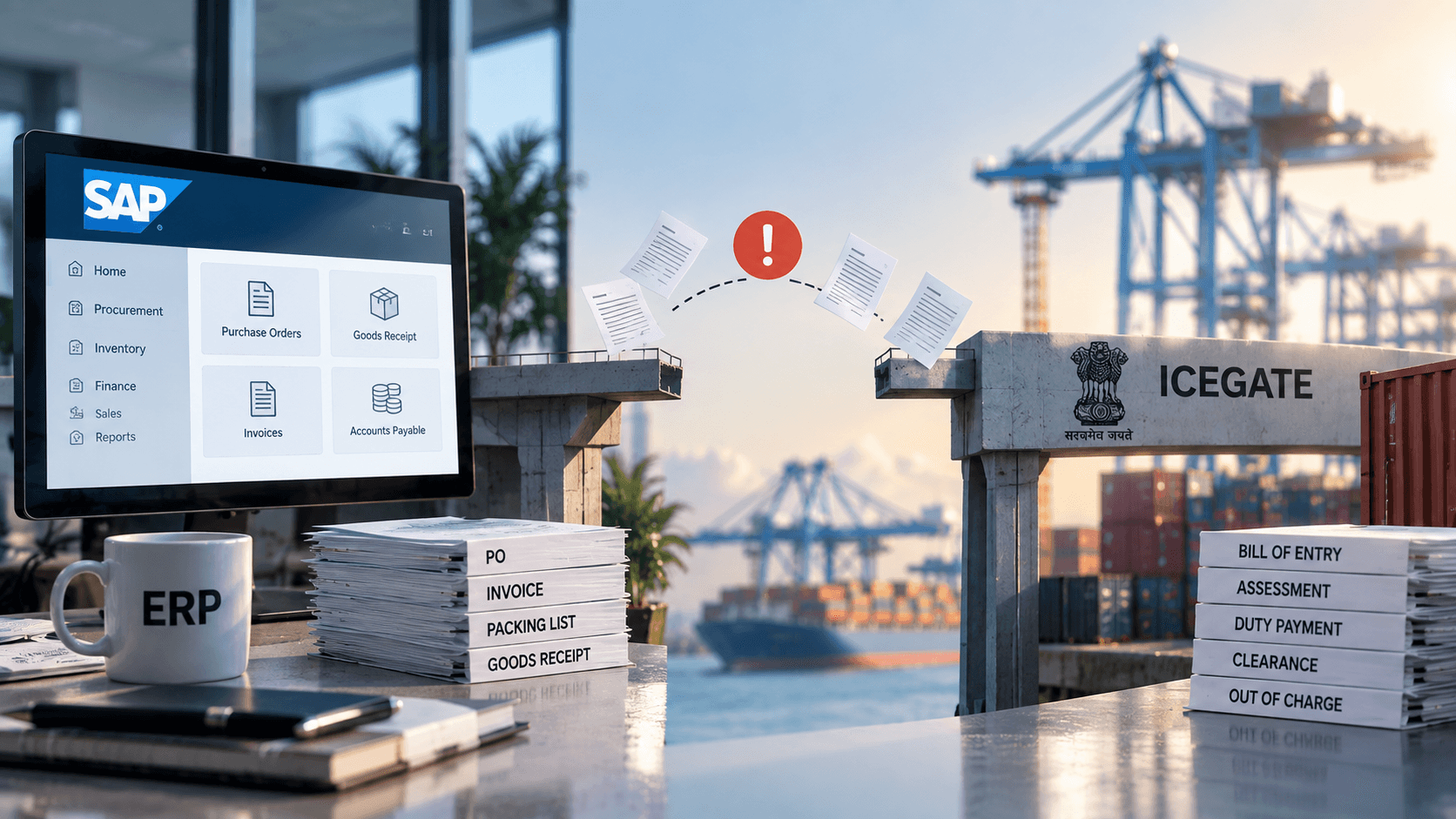
Every SAP-run import operation has the same structural shape. A purchase order gets raised in SAP. Eventually, a goods receipt note gets posted in SAP. Between those two events, on a live shipment, SAP has almost nothing to say.
It doesn't know the vessel departed. It doesn't know the container reached transshipment. It doesn't know the Bill of Entry was filed, whether it was accepted or held for a query, what duty was actually assessed, or whether the container is sitting at port accumulating demurrage right now. All of that happens in ICEGATE, in the CHA's workflow, and in carrier portals, systems that were designed around customs and shipping processes, not around procurement and finance.
This isn't a configuration problem you can fix with a custom SAP report or a Basis team project. It's a data source problem. SAP cannot show you data it was never fed.
What SAP Tracks | What's Actually Happening in Transit |
|---|---|
PO raised, PO value, vendor | Vessel schedule, transshipment status, current location |
GRN posted, quantity received | Bill of Entry filing status, ICEGATE query status |
Standard cost or PO value | Actual assessed duty, IGST paid, port charges billed |
Vendor payment terms | CHA filing progress, document status, pending queries |
Nothing until GRN | Free-day countdown, demurrage risk, container hold status |
Why SAP GTS Doesn't Close the Customs Clearance Gap
Some larger importers have deployed SAP GTS (Global Trade Services) alongside their core SAP system specifically for trade compliance. It's worth being precise about what GTS actually does, because it's often assumed to solve a problem it wasn't built for.
GTS handles classification, restricted party screening, preference determination, and electronic filing to customs authorities where a certified interface exists. What it doesn't do is give your operations team a live view of where a physical container is, coordinate document exchange with your CHA, track a free-day countdown against a specific vessel's arrival, or reconcile the CHA's actual invoice against what was estimated. GTS is a compliance and declarations layer. The operational tracking layer, the part your import team lives in every day, still sits outside SAP entirely.
Most mid-sized importers running SAP for procurement and finance haven't deployed GTS at all. For them, the gap is even wider: no compliance layer and no operational tracking layer connected to the ERP.
The Three Business Consequences of the Gap
Finance makes pricing and cost decisions on stale numbers. Landed cost, the number that actually matters for pricing and vendor negotiation, includes customs duty, IGST, port charges, CHA fees, and inland transport. None of that flows into SAP automatically. Finance assembles it manually from the CHA's final invoice and port charge receipts, typically weeks after the shipment has closed. By the time the real number is in SAP, the pricing decision it should have informed has already been made.
Production planning runs on estimated ETAs instead of actual customs status. A vessel ETA is not a delivery date. A container can arrive on schedule and still sit at port for days if a document query hasn't been resolved or a checklist hasn't been approved. SAP has no way to distinguish "on the water, on time" from "at port, held for a query," because that distinction only exists inside ICEGATE and the CHA's workflow, systems SAP isn't connected to. Production teams plan against the ETA because it's the only date they have, and then absorb the disruption when the actual clearance date is different.
Duty payments and cost variances surface only at manual reconciliation. When a duty rate changes, or a misclassification is corrected, or a port charge comes in higher than estimated, that impact doesn't touch SAP until someone manually re-enters it. Between the moment the shipment clears and the moment finance reconciles it, the company's own ERP is showing a number that finance already knows is wrong and hasn't had time to correct.
What Closing the Gap Actually Requires
Closing this gap doesn't mean replacing SAP or building a parallel system for trade operations. It means connecting the two data worlds that currently don't talk to each other: SAP's procurement and finance records, and the operational reality of customs filing, shipment tracking, and CHA coordination.
XEMI runs two-way live sync with SAP and Oracle, so PO-to-GRN status inside SAP updates automatically as the shipment moves through ICEGATE filing, duty payment, and clearance, instead of waiting for someone to key it in after the fact. Finance and procurement teams see what's actually happening in transit inside the same SAP screens they already use, not in a separate portal they have to remember to check. This ERP sync works alongside XEMI's document validation and customs filing automation, and XEMI importers overall report average customs clearance time down to 3 days, from 7, with 70 to 80% less manual team time spent per shipment.
This doesn't replace SAP as the system of record, and it doesn't replace your CHA's filing expertise or your team's judgement on exceptions. It closes the specific gap between what SAP records and what's actually happening to your shipment, so both systems are working from the same current reality
FAQ
Frequently asked questions
Does SAP show real-time customs clearance status?
No. SAP tracks purchase orders and goods receipts but has no native connection to ICEGATE, so it cannot show live Bill of Entry status, customs queries, or duty assessment without a separate integration feeding that data in.Is SAP GTS enough to track shipments and customs status in India?
SAP GTS manages trade compliance functions like classification, restricted party screening, and electronic filing where a certified interface exists. It doesn't provide live shipment tracking, CHA document coordination, or free-day and demurrage monitoring, which sit outside its scope.Why does landed cost show up late in SAP?
Landed cost depends on data from multiple external sources, the CHA's invoice, port charge receipts, and the actual duty assessed at customs, none of which flow into SAP automatically. It typically gets entered manually after reconciliation, often two to three weeks after the shipment closes.Can SAP be integrated with ICEGATE and customs systems in India?
Yes, through a two-way integration layer built specifically for that purpose. XEMI provides two-way live sync between SAP or Oracle and customs and shipment data, so PO-to-GRN status reflects what's actually happening at ICEGATE and at port in real time.What happens to production planning when SAP only shows the vessel ETA?
Production teams plan against the estimated arrival date because it's the only date available in SAP, but an ETA doesn't account for customs holds, document queries, or port delays that can add days after the vessel physically arrives, which is a common source of production disruption for importers running just-in-time schedules.