
Landed Cost Calculation India: Why Most Importers Get It Wrong and What It Costs Them
Most Indian importers price on invoice value, not landed cost. See the real BCD, SWS, IGST and CHA fee stack, a worked example, and what it costs when it's wrong.
What Actually Goes Into Landed Cost
Ask an import manager what a shipment costs, and most will quote the invoice value, maybe with a rough duty percentage added on top. That number is wrong in a predictable way, and it's wrong in the same direction every time: too low.
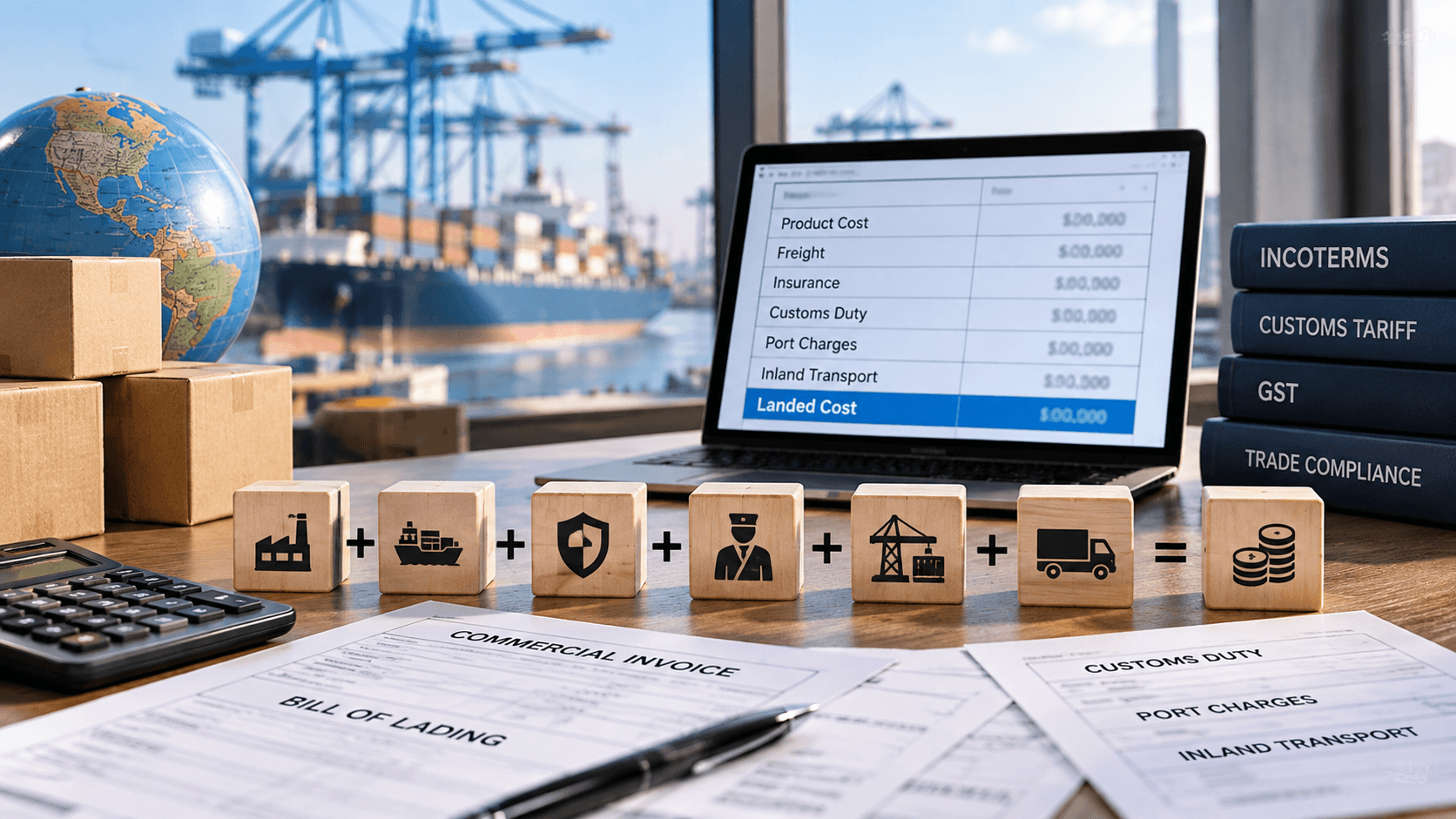
A complete landed cost figure includes:
- CIF value, the cost of goods, plus international freight, plus insurance
- Basic Customs Duty (BCD), charged on the CIF (assessable) value, at a rate set by the product's HSN classification
- Social Welfare Surcharge (SWS), 10% of the BCD amount, not 10% of CIF
- IGST is charged on the CIF value plus BCD plus SWS, at the domestic GST rate for that product. Under the GST 2.0 rate rationalisation effective September 22, 2025, this is 5% or 18% for most goods, with a 40% rate reserved for a short list of luxury and sin goods
- Anti-dumping or safeguard duty, where applicable to the specific HSN and country of origin
- Port and terminal handling charges, CFS charges, and documentation fees
- CHA professional fees for filing and clearance
- Inland transport from port to warehouse
- Finance cost on duty paid upfront, since duty is typically paid before the input tax credit on IGST is usable
The IGST calculation is where most manual estimates break down. IGST is not applied to the invoice value. It's applied to CIF value plus BCD plus SWS combined, which means the duty compounds on itself before GST is even added. A spreadsheet built on "invoice value times duty rate" will consistently understate the real number.
A Worked Example
Take a shipment with a CIF value of ₹10,00,000, a BCD rate of 10%, and an IGST rate of 18%.
Step | Calculation | Amount |
|---|---|---|
CIF (Assessable) Value | Given | ₹10,00,000 |
Basic Customs Duty (BCD) | 10% of CIF | ₹1,00,000 |
Social Welfare Surcharge (SWS) | 10% of BCD | ₹10,000 |
IGST Base | CIF + BCD + SWS | ₹11,10,000 |
IGST | 18% of IGST Base | ₹1,99,800 |
Total Customs Liability | BCD + SWS + IGST | ₹3,09,800 |
Landed Cost Before CHA Fees, Port Charges, Inland Transport | CIF + Total Customs Liability | ₹13,09,800 |
That's roughly 31% above the invoice value before a single rupee of CHA fees, port handling, or last-mile transport is added. For a company doing 80 to 100 shipments a month, that gap between "what we assumed" and "what it actually cost" shows up as margin erosion that nobody can point to a specific cause for, because it never got tracked at the shipment level in the first place.
Where HSN Misclassification Quietly Breaks the Number
Every input in this formula depends on one thing getting right at the very start: the HSN classification. Get the HSN code wrong, and the BCD rate is wrong, which means the SWS is wrong, which means the IGST base is wrong, which means every downstream number is wrong.
This is not a rare event. Import operators classifying from memory, using the code that was used on the last ten shipments of the same product, is normal practice in most import teams. Tariff schedules change. CBIC issues reclassification notifications. A code that was correct eighteen months ago may not be correct today, and because a misclassified filing usually still clears customs without immediate rejection, the error runs quietly across every subsequent shipment until someone catches it, often during an audit.
The financial exposure runs in both directions. Under-classification creates compliance risk and potential penalties on audit. Over-classification means duty overpayment that accumulates, shipment after shipment, without triggering any internal alert, because nobody is comparing the classification against current tariff data at the point of filing.
Why SAP Alone Doesn't Solve This
Most mid-sized and large importers running SAP or Oracle assume their ERP gives them landed cost visibility. It doesn't, not in real time. SAP knows a purchase order was raised and a goods receipt was posted. It has no native visibility into the customs filing, the actual duty paid at ICEGATE, the CHA's invoice, or the port charges billed separately weeks later.
The result is a manual reconciliation cycle. Someone on the finance team pulls the CHA invoice, cross-checks it against the Bill of Entry, matches port charge receipts, and enters the true landed cost into SAP after the fact, often two to three weeks after the shipment has already cleared and the goods are already on the shelf or the production line. Pricing, vendor negotiation, and profitability decisions get made on a number that is, by definition, out of date the moment it's finalised.
What Changes When Landed Cost Is Calculated Automatically
XEMI Finance extracts cost data (freight invoices, customs duty statements, port charge receipts, CHA invoices, and transporter bills) automatically, categorises each cost, and links it to the correct shipment, so total landed cost is visible at the shipment, invoice, and product level before the cargo even arrives, not weeks after the shipment closes.
XEMI's HSN 360 engine checks classification against current tariff data and flags duty overpayments automatically when a misclassification is detected, with a guided recovery path. XEMI customers have recovered ₹12 Cr+ in duty overpayments through this process. XEMI Finance also runs two-way sync with SAP and Oracle, so the true landed cost figure updates inside the ERP your finance team already works from, instead of living in a separate spreadsheet that someone has to remember to update.
None of this replaces the CHA's classification judgement or your finance team's oversight. It gives both of them the current, complete number to work from, instead of a partial one assembled after the decisions have already been made.
FAQ
Frequently asked questions
What is included in landed cost for imports into India?
Landed cost includes the CIF value of the goods, Basic Customs Duty, Social Welfare Surcharge, IGST, any applicable anti-dumping or safeguard duty, port and terminal charges, CHA fees, inland transportation to the warehouse, and the finance cost of paying duty before the goods are sold.How is IGST calculated on imports in India?
IGST is calculated on the CIF value plus Basic Customs Duty plus Social Welfare Surcharge combined, at the domestic GST rate applicable to that product. Since the GST 2.0 rate rationalisation took effect on September 22, 2025, this is 5% or 18% for most goods, with a 40% rate applying only to a short list of luxury and sin goods, not the old four-slab structure. It is not calculated on the invoice value alone.Is Social Welfare Surcharge calculated on CIF value or on BCD?
Social Welfare Surcharge is calculated at 10% of the Basic Customs Duty amount, not 10% of the CIF value. This is a common source of manual calculation errors.Why doesn't SAP show real-time landed cost?
SAP tracks purchase orders and goods receipts, but it doesn't have native visibility into customs filings, actual duty paid at ICEGATE, or CHA and port invoices that arrive separately. Without an integration that pulls this data in automatically, landed cost is usually reconciled manually, weeks after the shipment closes.How does HSN misclassification affect landed cost?
An incorrect HSN code changes the applicable BCD rate, which changes the SWS and IGST calculated on top of it. Because misclassified filings often still clear customs, the error can repeat across many shipments before it's caught, either as duty overpayment or as compliance exposure discovered at audit.